Our History
Our story is written in ink.
Huber’s ink.
When Joseph Maria Huber arrived in New York from Germany in 1883, he was greeted by an America that was bursting with industry and invention, including the rapid spread of newspapers, magazines and advertising. Just as railroads, telephones and steam engines had transformed daily life, so too would the emergence of mass media. It would push American popular culture across the globe.
Against this backdrop, Joseph Maria Huber launched his business with a single manufacturing plant. Huber’s dry colors were pigments used to produce inks. Over the years, the J.M. Huber Corporation has evolved—entering new markets, serving new industries, expanding its global presence. Yet one thing has remained unchanged: the importance of family ownership.
Today, Huber is one of the largest privately held companies in the US. As the company enters its sixth generation of family ownership, it continues to carry on the legacy of Joseph Maria Huber by adhering to the Huber Principles, the foundation for the way the company conducts business everywhere it operates.
Huber Highlights
The Early Years: 1883-1933
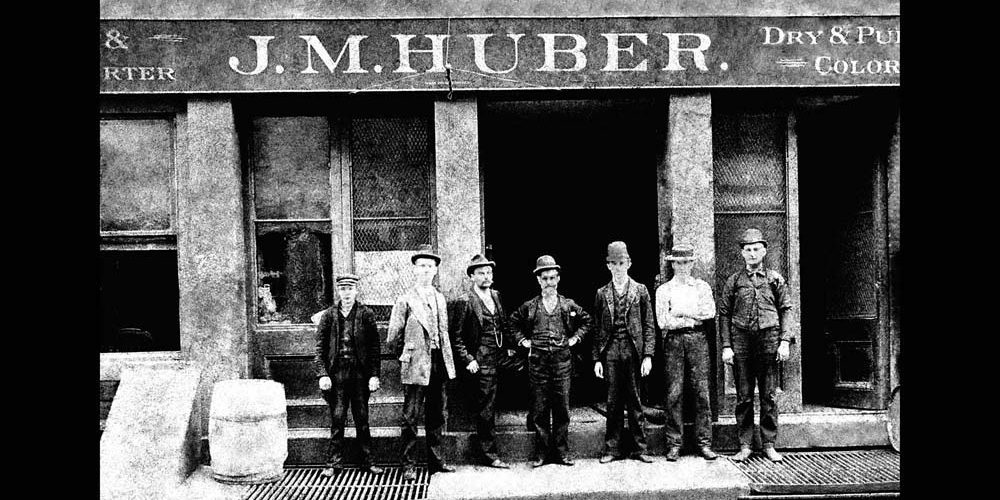
In 1883, Joseph Maria Huber arrives in America as a salesman to develop new markets for his family’s dry colors business. Although he did not set off on his own until some years later, the J.M. Huber Corporation considers this to be its founding date, not only because its founder fell in love with America at first sight, but also because his early activities here made all future business possible. He opens his first dry color plant in Brooklyn, New York, in 1891.
Starting in the 1920s, Joseph begins transitioning control of his company to his sons, but remains active in its affairs until his death in 1933.
Foundation of Huber Engineered Materials and Huber Resources Corp: 1941-1981
Investment in timberlands begins in 1941 with the purchase of a tract of land in Maine. This marks the beginning of the Timber & Minerals business, the forerunner of today’s Huber Resources Corp.
Huber Engineered Materials (HEM) also traces its origins to this period. A 1946 patent for silicates marks Huber’s entry into specialty chemicals. A key building block of HEM’s Ground Calcium Carbonate business is the Calcium Carbonate Company, purchased in 1973. In 1981, Huber acquires Solem Industries, an alumina trihydrate (ATH) manufacturer, which becomes the foundation for HEM’s Fire Retardant Additives (FRA) business.
Origins of Huber Engineered Woods and strengthening our culture: 1983-1990
Huber celebrates its 100th anniversary in 1983. At the century mark, the Huber portfolio consists of: Printing Inks, Carbon Black, Oil & Gas, Timber & Minerals, Chemicals, Clay, Calcium Carbonate, Solem, East-Tex Plastics and Equipment.
In the same year, Huber enters a new market by opening a plant in Easton, Maine, to produce oriented strand board (OSB) for the construction industry. This forms the foundation of today’s Huber Engineered Woods (HEW).
Mike Huber introduces the Huber Principles in 1987 to serve as a guidepost for the company’s core values. The initial foundation for our Principles came from Joseph Maria Huber (Mike’s grandfather). Although the Principles have evolved over time as Huber has become more diverse and international, our underlying four core values are essentially the same—and growing stronger 135 years later.
Transforming the company: 1994-2009
For its first century of existence, Huber’s activities remain largely centered on ink. In 1994, fourth-generation Huber family member Peter Francis becomes CEO and initiates a major restructuring initiative to focus the company on specialty products. During his tenure, the company divests some of its oldest businesses, including Ink and Clay.
Huber enters the carboxymethyl cellulose and hydrocolloids industries in 2001 by acquiring Noviant and then expands its influence in 2004 by acquiring CP Kelco, Huber’s largest acquisition to date.
A focus on specialty materials: 2010-present
In response to the global financial crisis, CEO Michael Marberry accelerates Huber’s transition to the specialty products company. As a result, Huber exits the energy industry in 2011 and sells its timber properties to improve cash flow. Huber Resources Corp arranges long-term contracts to manage many of the properties for their new owners.
HEM’s 2012 asset purchase of the business now known as Huber Specialty Hydrates becomes core part of its FRA unit, bolstered in 2016 by the acquisition of Martinswerk, which establishes HEM as a global FRA leader.
Huber marks its 135th anniversary in 2018. In 2019, HEM enters the agricultural space with the acquisition of Miller Chemical & Fertilizer, LLC. The Huber portfolio today consists of CP Kelco, Huber Engineered Materials, Huber Engineered Woods and Huber Resources Corp.